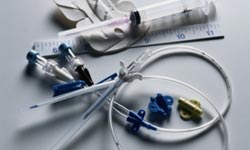
My reunion with the catheter happened in 2021. I wish it had been much sooner. By now I was virtually unable to pass any liquid and my quality of life had plummeted. I was in permanent pain, exhausted and dealing with a constant urge to go to the toilet.
Night time was the worst. Going to bed held no attraction. I didn't sleep.

I kept an empty Sainsbury cranberry juice carton beside the bed so that I didn't have to keep making the long trek to the loo.
On a good night I only got up to try to pee 6 or 7 times. On a bad night (nearly every night was a bad night) it was over 15 times. On a very bad night it was over 20. My record on March 3rd 2021 was 26 times. By the end of that night there was less than half a cup of pee in the container and I was in despair.
In a 5 page pleading letter of desperation to my hospital's urology department in April 2018 I begged them to find a way to treat me, writing the following:
'Between the acute pain and the unending lack of sleep I am permanently exhausted. The result of this is that I feel physically and mentally broken. My sense of myself in the world has changed. My confidence is at rock bottom. I feel inadequate and extremely insecure. I don’t socialise in any form anymore. I frequently have to turn work down knowing I won’t be able to function properly. Running to the toilet every 10 minutes doesn’t look good to clients. In short - I am in crisis ...'
My plea fell on deaf ears. There was no reply. Little did I know then that I was over 600th on a National Health Service waiting list of men in the same desperation as me - and that was just in my small part of the world.
In May 2020 - 2 years and one month later I finally got an appointment for a uroflow test. This complex sounding test takes less than an hour most of which is spent by the patient waiting to pee in to a cup so that your flow rate can be estimated. It's that basic - no scans or prodding or being plugged up to a machine - just you, a big jug of water, and a pee pot and a toilet cubicle.
On arrival I was met by a very pleasant female nurse called Cathy. Softly spoken and very calm she talked me through what was going to happen. I'd drink as much water as I could, then wait until I needed to pee. When I had done that the urodynamics test would be complete and I could leave.

She handed me a two litre jug of water and I began drinking as instructed. Given that I was in a hospital urology department I assumed I was in safe hands and that the nurse knew what she was doing but drinking so much water was worrying to me. In the previous months and years I had worked hard at limiting my liquids intake. How I was going to get so much of the bloody stuff back out of me now!? It felt like I was walking voluntarily into an act of self-harm.

With several large cups of water consumed I sat and waited. I'd felt the need to pee even before I'd arrived (the urge was constant) but as the water moved out of my stomach and down to my bladder** the urge grew steadily.
** little known fact - from the stomach water takes a very circuitous path to the bladder - small & large intestine - blood stream - liver - heart - blood stream again - cells - blood stream again - kidneys - bladder.
There was one other 'patient' in the large featureless room in a characterless building on the Lisburn road in Belfast. We acknowledged each other from a distance but didn't talk. What would there have been to say? - "So what are you in here for!?" "How are you feeling?" I paced the room to speed up my need to pee. Around 20 minutes after my water intake the familiar stinging pain kicked in and set my dick on fire. Nurse Cathy was nowhere to be seen. When she eventually appeared she ushered me in to a toilet cubicle with a disposable cup to pee into. Despite my urgency only half a finger of pee passed out my urethra. The pain and urgency remained.

Collecting the cup, Cathy went off and measured it. On her return she questioned me about how normal this small amount of flow was. "This is my normality!" I told her. She asked how often I'd get up to pee during the night. "It can be more than 20 times." I said, concerned that she wasn't going to believe this ridiculously high figure, but she didn't question me and I could see that she was showing genuine concern. After asking what medication I had been prescribed and how effective I thought it was she paused for a moment and then said "Have you ever tried self-catheterisation?"
Whilst I knew from a previous encounter what catheterisation was I had no idea what the 'self' bit had to do with it. In my experience one had been pushed into me whilst I was unconscious and I had never even tried to work out how that had been done. It didn't bear thinking about at the time!
Nurse Cathy sat down beside me and quietly told me that she could see that I was in a lot of discomfort and that it might be worth me trying self-cathing. Still not understanding what the 'self' bit meant (my brain was shouting 'HOW DOES IT GET IN THERE FFS!?) I told her I'd try anything - ANYTHING AT ALL. It had taken me so long to get to this place - this medical environment - that I really didn't want to leave without some sort of intervention. I had built myself up to an expectation of being treated - being helped - maybe even being cured right there and then! Now just having been told to piss into a pot was worrying me so self-cathing was at least better than being told to go away and wait for the next appointment.
"I don't know what it involves but I'll try anything. What do you need me to do?" Cathy went away and returned with a small package. She explained that I needed to insert a tube up my urethra and asked me if I wanted guidance. I had no choice. We walked into a cubicle and she tore open the packet revealing a blue wrinkled tube attached in a circle. I unzipped, pulled out my penis and presented it to her with some degree of embarrassment. She unscrewed the join in the tube and it fell straight. It was a foot long! She asked if I wanted her to do the insertion for me or if I wanted to do it myself. At that moment I couldn't entertain the idea of performing this simple but very strange operation myself so I asked her to start it for me. "Can you lift the tip of your penis up towards me please?" she asked pulling the sterilised catheter outer sheath backwards to reveal the narrow tube. She lowered it to my urethral meatus (pee hole) and gently made contact.

"We're going in!" I uttered in a pathetic attempt to lighten the mood. Cathy had been here before and she'd doubtless heard all the banal issuances from embarrassed patients. "Just try to relax." she responded deadpan. Relax! Every muscle in my body was locked - except thankfully my ischiocavernosus and bulbospongiosus muscles - dick erection muscles. They were behaving themselves very well - as relaxed as a dehydrated cucumber.


The tip of the catheter slipped silently in to the urethral meatus and disappeared. Cathy skilfully fed it slowly into my body pulling back the flaccid protective cover as she went. "You're going to feel a little bit of discomfort in a moment as it passes through the swollen prostate. That's the narrowest part." A dunting hard pain suddenly hit me right behind my balls. I couldn't help crying out and Cathy stopped. "Would you like to take over now for the last bit?" she asked. I gathered the last of the tube and began pushing. The only pain I had was the pain of thinking I was in pain - serious man-flu pain.
A couple of inches later the end of the catheter suddenly began to flow with my pee. It spluttered and fanned out and I didn't direct it into the toilet bowl in time to stop it hitting the seat and then the floor. The sound was sweet music. I hadn't heard that sound of my piss splashing into a toilet in years and years. The sound of my bladder emptying! Fucking fucking fucking hell!
The flow continued for a few seconds before stopping abruptly. "There you go. You've done it!" exclaimed Cathy with all the gentleness of a mother comforting a child after a bad dream. "Feel better now?" Did I feel better!? The thing was - I didn't feel anything. The pain had gone. My body was without the pain of urinary retention. The non-feeling was wonderful. I stood in silence taking this significant moment in. My body had stopped hurting me. My prostate had backed off - stopped tormenting me. It was an unforgettable moment. I began sobbing quietly. The relief! Cathy just stood there giving me a moment. She knew her stuff. "Thank you so much." I couldn't thank her enough. I was drained in every sense of the word, weak at the knees and a little bit delirious and now sweating like I'd just finished a workout. "Better now I'm sure?" was all she said reassuringly. I answered with a moan of relief and "Ahhhhh I can't tell you nurse Cathy ...!"
You don't expect significant life experiences to happen in a toilet closet with a woman you don't know whilst holding your dick in your hands ... at lease I don't. You think you've seen it all but there's always something more.
As I came around, I was still holding my shrunken dick in my left hand with the spent catheter in my right. It now needed to be extracted. The thought of it coming out was nearly as bad as it going in. I began pulling it slowly. There was little resistance, just the faint sensation of something foreign rasping against the walls of my urethra. Then out slipped the back end like a train from a tunnel. One moment it had been floating around inside my bladder, the next sitting in my pee-soaked fingers. Bizarre.
As Cathy binned the catheter and I zipped up, the thought hit me that I had just been handed a solution to my urinary retention. Was I now going to be able to drain the contents of my bladder at will? Was this simple 10 inch plastic tube all I needed to stop the chronic pain I was enduring? It was an elating but confusing thought.
THANK YOU FROM THE BOTTOM OF MY HEART NURSE CATHY.
PLEASE SUBSCRIBE AND FEEL FREE TO CONTRIBUTE